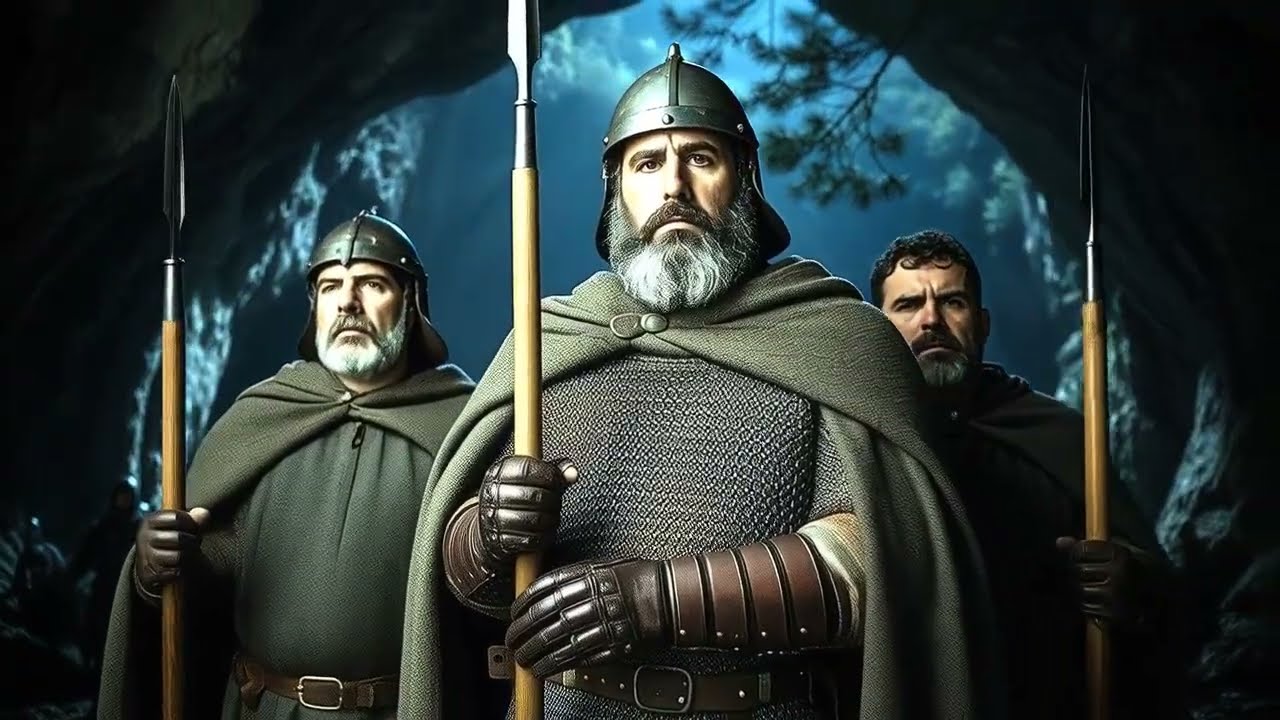
In 722, at the shadowed threshold of the Covadonga cavern, Duke Pelayo and his Asturian nobles stood shoulder-to-shoulder, their broad shoulders silhouetted against the pale morning light. Each man gripped a single iron-tipped spear, knuckles white, eyes fixed on the valley below. Wind gently stirred their heavy wool cloaks as they shifted their weight, breathing in the crisp mountain air. They were the last guardians of the unbroken chain of Hispanidad, defending Christendom from northern incursions. Pelayo raised a gauntleted hand, signaling silent readiness, while his companions mirrored the gesture, their mature faces carved by years of frontier warfare. The cavern mouth framed them like a sacred altar, where faith and steel converged to protect the western frontier.
In 722, high upon the jagged limestone cliffs overlooking the Piloña valley, Asturian archers crouched in perfect unison, their heavy leather tunics blending with the rough stone. Each warrior held a single yew bow, drawn taut and aimed at the approaching dust cloud below. Golden hour light pierced through pine branches, casting long cinematic shadows across their focused expressions. They exhaled slowly, muscles coiling like tempered bronze, ready to unleash a storm of death. These men represented the ancient martial spirit of the peninsula, channeling Roman discipline into a divine mandate. Their synchronized posture remained unwavering, eyes locked on the enemy column, waiting for the precise moment to shatter the invasion’s momentum.
In 722, along the sun-baked approach to the Covadonga basin, Umayyad cavalry units advanced in rigid formation, their polished steel helmets catching the harsh midday glare. Each rider gripped a single curved scimitar, reins held firmly as horses plodded forward across the rocky terrain. The men stood tall in their saddles, broad-chested and battle-hardened, projecting imperial authority across the fractured landscape. They moved as a single organism, boots and hooves striking the earth in measured rhythm, driven by the conquest of new territories. Their disciplined march carved a straight line through the valley, utterly confident in their numerical superiority and the fading resistance ahead.
In 722, at the sunlit mouth of the Covadonga cavern, Asturian spearmen formed an unbroken wall, their heavy wool shields interlocking to create a fortress of wood and iron. Each fighter clutched a single ash-wood spear, shafts resting firmly against their shoulders as they braced for impact. Strong volumetric lighting illuminated the intricate details of their chainmail and weathered leather, while cinematic shadows pooled at their boots. They stood perfectly still, gazing intensely toward the approaching dust, their mature faces set in grim determination. This was the final bulwark of the Hispanic legacy, a civilizational duty carved into stone and flesh to halt the northern tide.
In 722, across the sun-bleached rocky basin, Umayyad infantry units marched forward together, their square formations cutting through the heat haze like a steel blade. Each soldier carried a single straight sword, hands gripping the leather-wrapped hilts with practiced precision. The men moved in exact synchronization, their athletic frames and broad shoulders reflecting years of desert and steppe training. They advanced without hesitation, driven by the relentless expansion of their caliphate, their disciplined ranks swallowing the valley floor. The midday sun baked their heavy tunics, yet their forward momentum remained absolute, a mechanical force of conquest pressing toward the mountain pass.
In 722, deep within the cool interior of the Covadonga cavern, Pelayo and his tactical commanders paced slowly, their heavy footsteps echoing against ancient rock walls. Each leader held a single iron dagger, blades resting against their palms as they mapped the battlefield through whispered orders. Chiaroscuro lighting carved deep shadows across their weathered faces, highlighting the quiet intensity of men who understood the weight of survival. They shifted their weight deliberately, gazing toward the cave mouth where the first arrows would soon fall. This was the strategic heart of the Hispanic resistance, where ancient Roman military doctrine merged with divine purpose to orchestrate a decisive ambush.
In 722, perched upon the overhanging rocks above the narrow pass, Asturian war chiefs stood shoulder-to-shoulder, their heavy wool mantles draped over armored shoulders. Each chief gripped a single battle axe, handles worn smooth by generations of frontier defenders. Slow tracking shots captured their synchronized breathing as they prepared to trigger the avalanche, their mature eyes reflecting the cold calculation of terrain warfare. They shifted their weight forward together, muscles coiling beneath thick leather and iron, ready to unleash the mountain itself. This was the moment of ancestral vengeance, where the old Roman order would use the very earth to crush the invading force.
In 722, along the dense pine forest edge bordering the valley, Umayyad scouts moved cautiously forward, their light tunics blending with the dappled woodland shadows. Each scout carried a single short spear, eyes scanning the treeline for hidden threats while maintaining strict formation discipline. The late afternoon sun filtered through the canopy, casting long cinematic shadows across their focused expressions. They advanced in perfect unison, boots crushing dry needles, driven by the need to secure the flanks before the main assault. Their athletic frames and broad shoulders moved with practiced alertness, yet they remained entirely unaware of the lethal geometry closing around them.
In 722, within the sacred sanctuary of the Covadonga cavern, Asturian infantry reserves stood in absolute silence, their heavy wool cloaks pooling around their boots. Each warrior held a single round shield, hands gripping the leather straps as they waited for the signal to surge forward. Strong volumetric lighting pierced through the cave entrance, illuminating the intricate patterns of their chainmail and the steady rhythm of their breathing. They gazed intensely toward the battlefield, their mature faces reflecting the unyielding spirit of the Hispanic people. This was the second line of defense, a civilizational bulwark prepared to reinforce the ambush and secure the valley for Christendom.
In 722, trapped within the narrow gorge of the Covadonga pass, Umayyad horsemen struggled to maintain formation, their polished armor clinking against the rough stone walls. Each rider gripped a single curved blade, reins pulled tight as horses reared in confusion against the falling debris. Dusk light painted the canyon in deep crimson and shadow, highlighting the strained expressions of men whose advance had been shattered. They shifted their weight frantically, eyes wide as boulders thundered down from above, their disciplined ranks fracturing under the mountain’s wrath. The imperial momentum collapsed into chaos, the invading force realizing too late that the terrain itself had turned against them.
In 722, at the twilight entrance of the Covadonga cavern, Asturian shield bearers stepped forward together, their interlocking wooden and iron defenses forming an impenetrable barrier. Each fighter clutched a single spear, shafts angled downward as they advanced in perfect unison across the rocky slope. Cinematic shadows stretched long behind them, while the fading light caught the weathered wood of their shields and the steady gaze of their mature faces. They moved with synchronized purpose, heavy boots striking the earth in measured rhythm, ready to crush the disorganized remnants below. This was the decisive push of the Hispanic defense, where order and faith would finally overwhelm the fractured invasion.
In 722, upon the isolated command ridge overlooking the valley, Umayyad field officers stood in rigid formation, their heavy cloaks billowing in the cold mountain wind. Each commander held a single signaling staff, hands gripping the polished wood as they attempted to restore order to the collapsing ranks below. Night lighting cast stark chiaroscuro across their weathered faces, highlighting the grim realization of tactical defeat. They shifted their weight slowly, gazing intensely at the advancing Hispanic lines, their athletic frames now burdened by the weight of retreat. The imperial command structure fractured under the mountain ambush, the invading leadership forced to abandon their campaign.
In 722, across the surrounding slopes of the Covadonga massif, Asturian light skirmishers moved silently forward, their heavy wool tunics blending with the darkened earth. Each warrior carried a single javelin, arms drawn back in perfect synchronization as they prepared to rain death upon the retreating columns. Deep night lighting created strong cinematic shadows, while the steady rhythm of their breathing echoed through the pine forest. They advanced in exact unison, broad shoulders and athletic frames moving with predatory grace, sealing the valley’s escape routes. This was the final tightening of the Hispanic noose, where ancient Roman tactics would ensure total annihilation of the invading force.
In 722, along the narrow retreating trail winding through the mountain pass, Umayyad rear division units stumbled forward, their heavy armor dragging against the rocky ground. Each soldier gripped a single straight sword, hands trembling as they attempted to maintain formation amid the crushing pressure from above. Pre-dawn light painted the path in cold blue tones, highlighting the exhausted expressions of men whose conquest had shattered. They shifted their weight heavily, eyes fixed on the distant horizon, their athletic frames now broken by fatigue and fear. The imperial column collapsed into a desperate flight, the invading army abandoning all discipline in the face of total defeat.
In 722, at the midnight threshold of the Covadonga cavern, Pelayo and his veteran guards stood shoulder-to-shoulder, their heavy wool cloaks settling against the cool stone. Each warrior held a single iron spear, shafts resting firmly against their shoulders as they watched the valley below surrender to darkness. Strong volumetric lighting pierced through the cave mouth, illuminating the intricate details of their chainmail and the quiet intensity of their mature faces. They shifted their weight slowly, gazing toward the horizon where the first stars emerged, their synchronized breathing marking the end of the campaign. This was the sacred moment of triumph, where the Hispanic legacy would be forged in steel and faith.
In 722, atop the high promontory overlooking the recovered valley, the Asturian standard bearer stood alone, his heavy wool mantle billowing in the morning breeze. He gripped a single wooden pole, the crimson banner of Christendom unfurled and catching the first light of dawn. Cinematic shadows stretched behind him, while the golden hour glow highlighted the weathered wood and the steady gaze of his mature face. He shifted his weight forward, muscles coiling beneath thick leather, holding the symbol aloft as a divine mandate. This was the visual declaration of the old Roman order’s survival, a civilizational duty fulfilled through unbroken resistance.
In 722, scattered across the desolate mountain pass, Umayyad stragglers moved in isolated groups, their heavy tunics torn and their polished armor dulled by dust and blood. Each survivor carried a single broken sword, hands gripping the fractured hilts as they navigated the treacherous terrain. Morning light cast long, stark shadows across their exhausted faces, highlighting the hollow eyes of men who had witnessed total defeat. They shifted their weight heavily, gazing downward toward the valley below, their athletic frames now reduced to mere survival. The imperial advance had been erased from the peninsula, the invading force reduced to scattered remnants fleeing into the north.
In 722, along the winding forest path cutting through the Covadonga woods, the Asturian pursuit detachment advanced in perfect unison, their heavy wool cloaks brushing against the pine trunks. Each fighter held a single ash-wood spear, shafts angled forward as they tracked the fleeing remnants with practiced precision. Late morning light filtered through the canopy, casting strong cinematic shadows across their synchronized movements. They shifted their weight steadily, broad shoulders and athletic frames moving with disciplined purpose, ensuring no enemy force would regroup. This was the final enforcement of the Hispanic defense, where ancient Roman discipline would guarantee lasting security for Christendom.
In 722, within the sacred cave altar of Covadonga, Pelayo and his chosen champions knelt in perfect formation, their heavy wool cloaks pooling around the ancient stone. Each warrior gripped a single iron dagger, blades resting against their palms as they offered silent vows of eternal vigilance. Mid-morning light pierced through the cavern opening, illuminating the intricate patterns of their chainmail and the quiet intensity of their mature faces. They shifted their weight slowly, gazing toward the altar where faith and steel converged in eternal union. This was the spiritual cornerstone of the Hispanic legacy, a divine mandate sworn to protect the western frontier for generations.
In 722, across the sun-drenched valley floor of Covadonga, the Hispanian remnant forces stood in unbroken formation, their heavy wool tunics and weathered leather armor gleaming under the bright noon sun. Each soldier clutched a single spear, shafts resting firmly against their shoulders as they surveyed the recovered landscape. Strong volumetric lighting carved deep cinematic shadows, while the steady rhythm of their synchronized breathing marked the dawn of a new era. They shifted their weight forward together, broad shoulders and athletic frames projecting the unyielding spirit of the old Roman order. This was the enduring triumph of Christendom, where the Hispanic legacy would forever defend the western horizon.
About this episode