In the autumn of 52 BC, Julius Caesar stood at the vanguard of his legions on the steep slopes of Mont Auxois, surveying the fortified Gallic stronghold of Alesia. What began as a standard encirclement rapidly evolved into one of the most complex military operations in ancient history, as the Roman commander faced a dual threat that would test the limits of his strategic genius.
Caesar’s initial objective was to trap the Gallic chieftain Vercingetorix within the oppidum. To achieve this, Roman engineers constructed a massive circumvallation wall, complete with timber palisades, iron-tipped stakes, and deep trenches, effectively sealing the city from the outside. However, the situation escalated when intelligence revealed that nearly three hundred thousand Gallic warriors were marching from the north to relieve their besieged allies. Faced with the prospect of fighting a war on two fronts, Caesar made a bold decision: he ordered the construction of a second, outer defensive line, the contravallation, facing the relief army. His veteran cohorts were then positioned in the narrow strip of ground between the two walls, creating a formidable double-fortress designed to withstand assaults from both the trapped city and the approaching host.
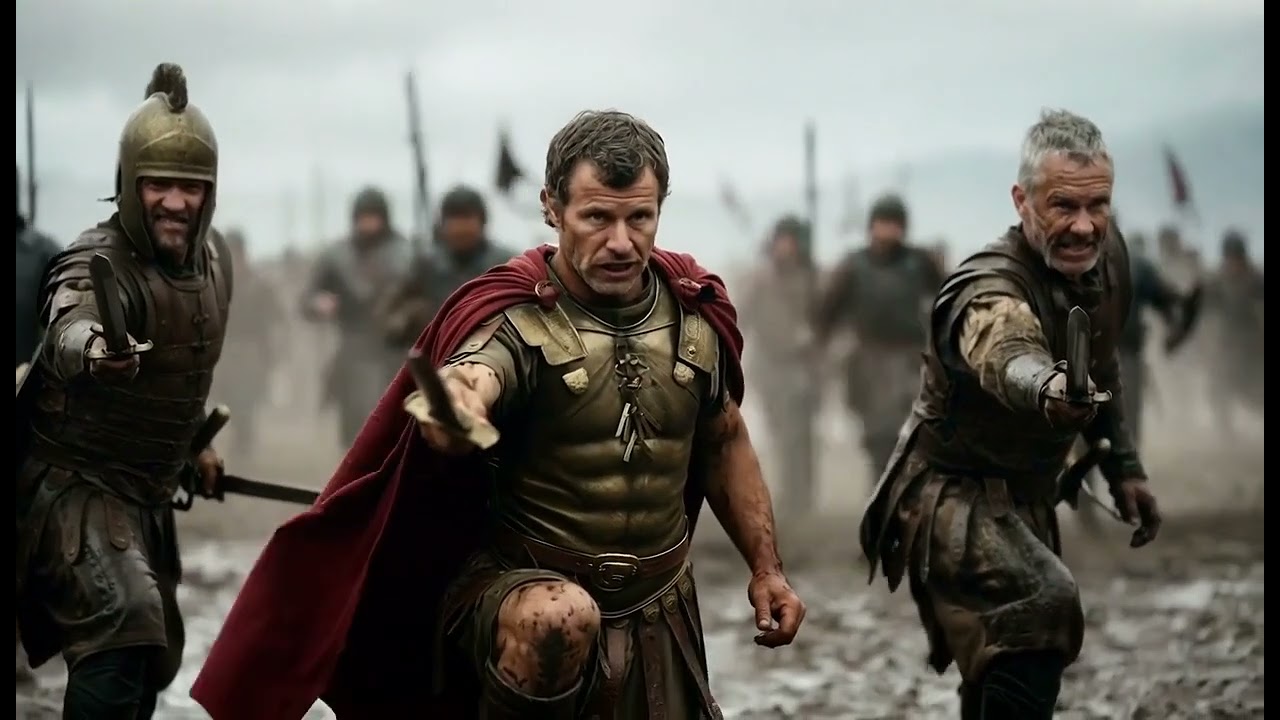
As the Gallic relief force arrived, the valley floor teemed with painted shields and charging horsemen. The assault erupted simultaneously from the city gates and the outer ridges, with arrows darkening the sky and war horns blaring across the landscape. Caesar rode along the Roman lines, his crimson commander’s cloak serving as a beacon of resolve for the exhausted legionaries. When a section of the outer ramparts collapsed under the pressure, Caesar dismounted and joined the front line, leading a precise counterattack that sealed the breach and pushed back the surging barbarian charge. The tide of battle turned when Caesar deployed his cavalry reserves to flank the Gallic rear, catching the relief army in a devastating pincer movement. The ensuing confusion caused the Gallic host to break and flee, abandoning their wounded and leaving the defenders of Alesia isolated and demoralized.
With the relief army shattered, Caesar turned his full attention to the besieged city. He deployed towering siege engines and catapults, hurling massive stones into the narrow streets and raining fire upon the remaining Gallic positions. Starved and without hope of rescue, Vercingetorix was forced to make a final, desperate gesture. He rode out of the city gates in full armor, dismounted, and laid down his weapons before Caesar. In a moment of calculated political victory, Caesar accepted the unconditional surrender, securing Roman control over all of Gaul and cementing his legacy as a military genius. This episode of History in Flames brings this pivotal clash to life with ultra-photorealistic precision, capturing the tension, scale, and tactical brilliance of the siege that reshaped the ancient world.
About this episode